
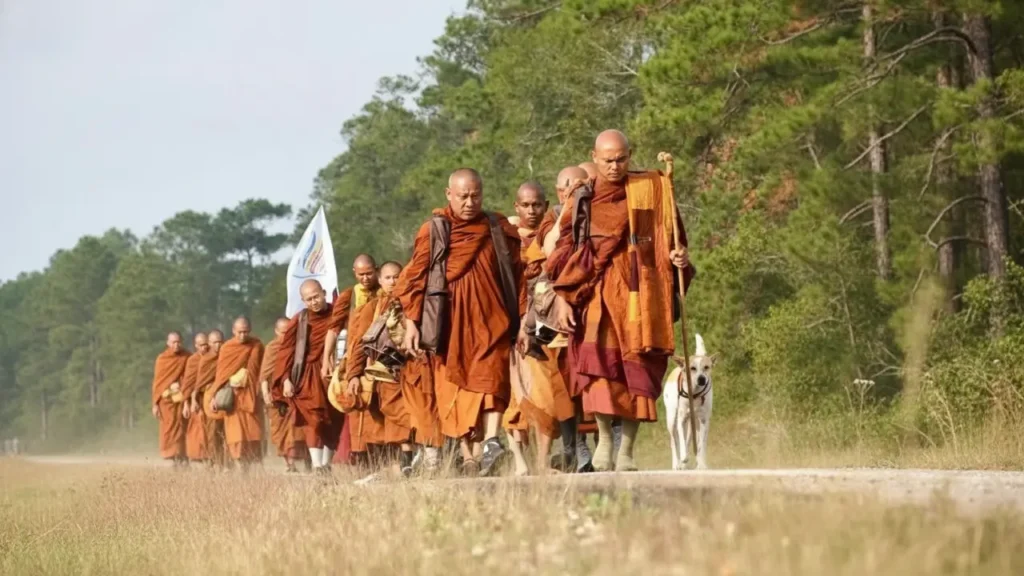
I was so inspired this past week watching the monks arrive in Washington, DC.
I’ve been watching video after video and unable to look away as 19 Buddhist monks completed a 2,300-mile walk from Fort Worth, Texas, to the steps of the Washington National Cathedral. 108 days. In saffron and maroon robes. Through scorching Southern heat, freezing winter storms, and icy sidewalks. Walking single file along highways and through small towns. Accompanied by a rescue dog named Aloka – Sanskrit for “divine light” who had joined the monks on a previous peace walk across India.
They arrived on February 10th to thousands of cheering supporters. Governors had issued proclamations along the way. Cities declared Walk for Peace Days. Nearly 3 million people followed their journey on Facebook. Almost 2 million on Instagram. One of the monks lost his leg in an accident during the walk and after recovering, he rejoined the group to finish.
Their leader, the Venerable Bhikkhu Paññākāra, stood before the crowd at the National Cathedral and said something I haven’t been able to shake:
“This walk was not to bring you any peace, but to raise the awareness of peace so that you can unlock that box and free it. All you need to do is just practice mindfulness to unlock that box where you have kept peace and happiness inside and locked it up and then left it somewhere. Now it’s your job. It’s your duty, to find it and unlock it. You’re the only one who can do this not the venerable monks, not the reverends, nor anybody else but you.”
He also said something beautifully practical: “Please don’t touch your phone when you wake up in the morning.”
Simple. Radical. And if you’re being honest with yourself probably the opposite of what you did today.
Why 108?
The monks didn’t choose 108 days randomly. Across Hindu, Buddhist, and Jain traditions, 108 is one of the most sacred numbers in existence. It represents infinity, spiritual completion, and the wholeness of all things.
The depth of this number is breathtaking:
There are 108 beads on a mala – the prayer necklace used for chanting mantras and meditation. Each bead represents one prayer, one mantra, one complete rotation toward spiritual awakening. When you chant 108 times, you’ve completed a full cycle of transformation.
There are 108 Upanishads – the ancient sacred texts that form the foundation of Hindu wisdom and philosophy, dating back thousands of years.
In Ayurveda, there are 108 marma points in the body sacred spots where consciousness meets flesh, where muscles, veins, and ligaments intersect as vital points of life force. When these points are out of balance, energy cannot properly flow through the body.
There are 108 energy lines (nadis) that converge to form the heart chakra – the energetic center of love, compassion, and connection.
In Buddhism, there are 108 earthly desires that must be overcome to achieve enlightenment – 108 passions and imperfections that the human soul must transcend.
Sun salutations in yoga are traditionally completed in nine rounds of twelve postures totaling 108.
Even the cosmos reflects this number: the diameter of the Sun is 108 times the diameter of the Earth, and the distance from our planet to the Sun is approximately 108 times the Sun’s diameter. In Sanskrit, 108 is called a Harshad number which literally means “joy-giver.”
When those monks chose 108 days for their walk, they chose a number that carries the weight of millennia of spiritual intention. Every step was a prayer. Every day was a revolution toward peace.
The Spark: From Inspiration to Action
Watching the monks’ journey immediately made me think of something I’ve been living and breathing for the past several years – the connection between peace, inflammation, and how we care for ourselves.
On February 3rd, just a week before the monks arrived in DC, I published my book. And in it, I introduce a concept I created called mental inflammation.
We all know physical inflammation – the joint pain, the gut issues, the autoimmune conditions, the fatigue. Three out of five people worldwide die from chronic inflammatory diseases. Sixty percent of American adults have a chronic illness. These numbers are staggering.
But there’s another layer of inflammation that we rarely name. It’s the inflammation caused by chronic stress, anxiety, overwhelm, a dysregulated nervous system, doom scrolling, political division, and living in perpetual fight-or-flight mode.
I call it mental inflammation because naming it gives us power over it.
Mental inflammation shows up as a scattered mind, emotional reactivity, insomnia, burnout, and that bone-deep exhaustion that no amount of sleep seems to fix. It’s what happens when our nervous systems have been running on high alert for so long that we’ve forgotten what peace feels like.
And here’s the truth that connects everything: Mental inflammation creates physical inflammation. When your nervous system is dysregulated, your body responds. Your digestion shuts down. Your immune system weakens. Your hormones become imbalanced. Your sleep suffers. Your inflammation markers spike. Your body breaks down.
But the reverse is also true. When you cultivate inner peace through consistent self-care practices, your nervous system settles. Your body heals. Your inflammation decreases. Your vitality returns.
The monks’ walk made me ask one question: How do we take their message of peace and put it into practice in our daily lives?
And then I realized Valentine’s Day is right here. A day dedicated to love. And the deepest love there is, is the love you give yourself.
The Invitation: 108 Days of Self-Love
What if we walked for peace within ourselves for the next 108 days?
Not across the country. Not in robes. Not as monks. But as mothers, entrepreneurs, professionals, caregivers, daughters, sisters, and friends who are ready to stop putting ourselves last.
My invitation to you: Join me for 108 acts of self-love.
One act. Every day. For 108 days.
Pick any practice that nourishes you and brings you back to yourself:
- Breathwork – even 5 minutes of alternate nostril breathing to calm your nervous system
- Meditation – sitting in stillness, walking in nature, or using a guided app
- Tongue scraping – a 2-minute morning ritual that removes overnight toxins and ignites your digestion
- Oil pulling – 15 minutes of swishing coconut or sesame oil to detoxify your mouth (your oral health is directly connected to your gut health and heart health)
- Self-massage – nourishing your skin and nervous system with warm oil, acknowledging gratitude for every part of your body
- Journaling – writing down your thoughts, your gratitude, or your intentions for the day
- Tea ritual – pausing for a warm cup of tea as a moment of pure presence
- Walking in nature – moving meditation without a podcast, without your phone, observing beauty with all your senses
- Sleep ritual – a consistent, loving bedtime routine that honors your body’s need for deep rest
- Cold water splash – waking up your eyes and nervous system each morning with cool water on your face
Or create your own practice. The specific practice matters less than the consistency and the intention behind it.
Seva: The Radical Act of Serving Yourself
There’s a beautiful Sanskrit word that captures what this 108-day journey is really about: seva.
Seva means selfless service – the act of serving without any expectation of personal gain. In Hindu philosophy, seva is considered a form of dharma (righteousness) and a path to moksha (spiritual liberation). The Bhagavad Gita teaches that one who performs their duties without attachment to the fruits of their action attains the Supreme. Seva is connected to karma yoga (disciplined action) and bhakti yoga (disciplined devotion), and the understanding that in serving others, we serve the divine.
Seva can be offered in three ways: through tan (physical service – the labor of your body), through man (mental service – teaching, guiding, listening), and through dhan (material service – sharing resources and wealth).
But here’s where I want to challenge your understanding of seva: What if the most radical act of selfless service you can offer right now is service to yourself?
This isn’t selfish. It’s necessary. It’s foundational. You cannot teach what you haven’t embodied. You cannot pour from an empty cup. You cannot offer peace to a divided world if you haven’t cultivated peace within your own body and mind.
When you commit to a daily self-care practice for 108 days, you are practicing seva. You are saying: My health matters. My peace matters. My nervous system matters. My body deserves care. My mind deserves rest. My spirit deserves nourishment.
And when you show up for yourself consistently, something shifts. You have more energy for others. You can show up more fully in your relationships. You become a source of peace in your home, your workplace, your community.
Vibrant health is contagious. Peace is contagious. It starts with you.
Why This Matters Right Now
We are living through a time of unprecedented anxiety, polarization, and disconnection. Our bodies are inflamed. Our minds are overwhelmed. Our nervous systems are running on fumes.
And we keep looking outward for solutions. We wait for someone else to fix it for the government to change, for the healthcare system to evolve, for some miracle cure to appear.
But the monks showed us something different. Long Si Dong, a spokesperson for their temple, put it simply: “It’s a spiritual offering, an invitation to live peace through everyday actions, mindful steps and open hearts. We believe when peace is cultivated within, it naturally ripples outward into society.”
What if the revolution starts with you? What if the peace the world needs begins with the peace you cultivate in your own body?
How to Begin
Step 1: Choose Your Practice. Pick one act of self-care that calls to you. Something that feels nourishing, not punishing. Something you can realistically do every day for 108 days.
Step 2: Set Your Intention. Why are you doing this? For peace? For healing? For self-love? For your family? For your community? Make it personal.
Step 3: Start Today. Don’t wait for Monday. Don’t wait for the new month. Start today — on Valentine’s Day, the day of love.
Step 4: Post It. Share your daily practice with #108DaysOfSelfLove. Tag me [@drshivanigupta]. Let me cheer you on. Let others be inspired by your commitment.
Step 5: Invite Someone. Tag a friend, a sister, a mother, a colleague who needs this. We heal in community. The monks didn’t walk alone and you don’t have to either.
A Guide for the Journey
If you’re looking for guidance on which practices to explore or if you want to understand the deeper science behind why these rituals work – I wrote a book for exactly this moment.
The Inflammation Code: Ancient Wisdom Meets Modern Medicine for Women Who Refuse to Settle published on February 3rd with Hay House. It’s the culmination of over 20 years of studying, practicing, and teaching Ayurveda – the 5,000-year-old Indian system of holistic health.
The book includes an entire chapter on daily self-care rituals – the very practices I’m inviting you to choose from for this 108-day journey. Breathwork techniques, meditation approaches for every personality type, tongue scraping, oil pulling, dry brushing, self-massage, nasal irrigation, tea rituals, and sleep hygiene protocols. Each one is explained with the ancient wisdom behind it and the modern science that validates it.
I also go deep into mental inflammation – what it is, how it manifests in your body, and how to cool those fires. You’ll discover your personal Elemental Design (your unique combination of Vata, Pitta, and Kapha forces) so you can customize every practice to YOUR specific biology. Because there is no one-size-fits-all approach to healing. What works for you may not work for your sister, your best friend, or your mother. This book helps you figure out what YOUR body needs.
There’s also a free 21-Day Inflammation Reset Program on my website – 21 days, 21 videos, and a community to support you – that pairs beautifully with this 108-day commitment.
But here’s the most important thing I want you to hear: You don’t need the book to do this.
You just need to choose yourself. You just need to show up. You just need to start.
The book is there if you want deeper guidance. But the 108-day commitment works with whatever you already know. Start where you are. Start with what you have. Start today.
The Sacred Walk Begins
Paññākāra told the crowd: “It might take seven days, seven months, or seven years to find inner peace. But each and every single one of us, we have our own path, and please remember, don’t expect our path to be smooth and flat.”
Your path starts with one step. One practice. One day. And then you do it again tomorrow. 108 times. Until you’ve walked yourself home.
The monks walked 2,300 miles to Washington, DC, carrying a vision of peace for a divided nation. Their walk is over. But ours is just beginning.
The monks walked to DC. We walk home to ourselves.
Who’s in?
Share your commitment below. Post your daily practice with #108DaysOfSelfLove. Tag me on Instagram and Facebook [@drshivanigupta]. Let’s walk this path together – one act of self-love at a time.
Because the only way to change the world is to change ourselves first.
– Dr. Shivani Gupta
#walkforpeace #peacewalk #108actsofselflove #valentinesday