
Can Inflammation Cause Weight Gain? The Answer Is Yes — Here’s Why
She’s eating the same. Exercising the same. But her body is not responding the same. The answer isn’t effort. It’s inflammation.
She’s eating the same.
She’s exercising the same.
But her body is not responding the same.
The scale inches up. Her midsection feels softer. Her clothes fit differently. And she asks the question I hear constantly: “What am I doing wrong?”
In many cases, the answer isn’t effort. It’s inflammation. And once you understand why, everything about your approach changes.
How Inflammation Influences Metabolism
Can inflammation cause weight gain?
Chronic low-grade inflammation can influence insulin signaling, cortisol regulation, and fat storage pathways — altering the hormonal and cellular environment that determines how your body stores and uses energy. Research shows it is associated with insulin resistance, metabolic syndrome, and changes in how adipose tissue behaves.¹
This doesn’t mean inflammation directly “creates fat.” But when inflammatory tone increases, metabolic flexibility often decreases. Inflammation doesn’t just affect joints or digestion. It affects metabolism.
Inflammation and Insulin Resistance
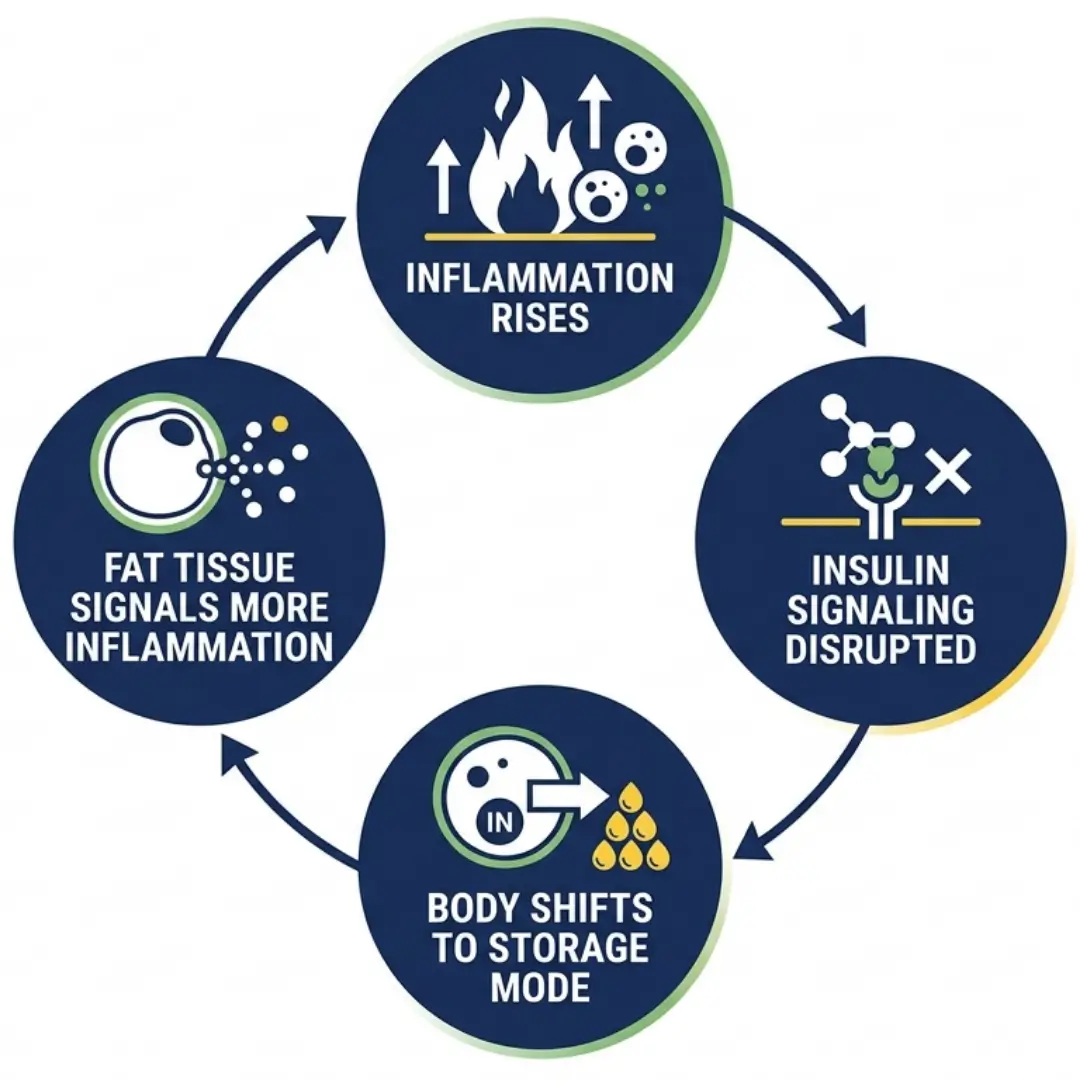
Insulin is a hormone that helps move glucose from the bloodstream into cells for energy. When inflammatory cytokines including TNF-alpha and IL-6 increase, they can interfere with insulin signaling pathways.² This is often called inflammation-induced insulin resistance.
Inflammation increases
Inflammatory cytokines (TNF-alpha, IL-6) rise due to stress, poor sleep, gut permeability, or hormonal shifts.
Insulin signaling is disrupted
Cells become less responsive to insulin. Blood sugar remains elevated longer. The pancreas releases more insulin.
Body shifts toward storage mode
Storage mode favors fat accumulation — particularly around the midsection.
Fat tissue produces more inflammatory signals
Adipose tissue is metabolically active — it produces cytokines (adipokines)³ that feed back into the loop, amplifying the original signal.
This is not simply about calories. It’s about signaling. And it’s how chronic inflammation and weight gain can reinforce each other over time.
Cortisol, Stress, and Belly Weight

Stress physiology adds another layer. Chronic stress influences the HPA axis — the system that regulates cortisol. When stress becomes persistent, cortisol rhythm can become dysregulated, and dysregulated cortisol is associated with increased abdominal fat storage and metabolic changes.⁴
If chronic stress is also increasing inflammatory signaling — which research shows it does² — then you have two overlapping drivers pointing in the same direction. Stress plus inflammation, both influencing metabolism simultaneously.
Why Dieting Harder Often Backfires After 35

When women notice weight gain, the instinct is often: eat less, train harder, be stricter. But aggressive restriction increases physiological stress. And physiological stress can elevate cortisol, disrupt sleep, destabilize blood sugar, and increase inflammatory signaling.
“If inflammation and weight gain are already linked through metabolic dysregulation, adding more stress rarely resolves the root issue. In fact, it often amplifies it.”
— Dr. Shivani GuptaThis is why so many capable, disciplined women feel like their metabolism “broke.” It didn’t break. It adapted to stress and inflammation. The solution is not more discipline. It is more regulation.
After 35, and especially during perimenopause, estrogen fluctuations influence immune modulation and metabolic regulation simultaneously. When estrogen becomes inconsistent, inflammatory sensitivity increases. At the same time, sleep often becomes lighter, stress recovery slows, and muscle mass begins to decline. Each of these factors influences metabolic rate and glucose handling. So when women search “why weight gain after 40,” the answer is layered: hormones, stress, inflammation, and metabolic adaptation. Not laziness. Not lack of discipline. Physiology.
What Actually Supports Metabolic Balance

If inflammation influences metabolism, then supporting inflammatory regulation supports metabolic stability. This doesn’t require extremes. It requires structure.
Blood sugar stability
Balanced meals with protein and fiber reduce glucose volatility and help maintain insulin sensitivity. This is not about restriction — it’s about steadiness.
Sleep timing
Sleep restriction influences both inflammatory markers and glucose metabolism.⁵ Consistency matters as much as duration.
Muscle support
Muscle tissue improves glucose disposal and metabolic flexibility. Strength training done intelligently — not exhaustingly — supports metabolic health without adding stress load.
Nervous system regulation
Chronic stress increases inflammatory signaling and disrupts cortisol rhythm.² Daily nervous system regulation — even five minutes — reduces cumulative inflammatory load in ways nothing else can.
Anti-inflammatory botanical support
Curcuminoids and polyphenols have been studied for their role in supporting healthy inflammatory balance.⁶ When inflammatory signaling stabilizes, metabolic signaling often follows. Consistency matters more than dose.
The reframe that changes everything
Stop chasing weight loss. Start supporting metabolic stability.
Weight often responds when signaling stabilizes. When inflammatory tone decreases, insulin signaling improves, cortisol rhythm stabilizes, and energy becomes more predictable. This is not instant. It is cumulative. But it is sustainable — because it’s working with your body’s physiology instead of against it.
Frequently asked questions
Can inflammation cause weight gain?
Yes. Chronic low-grade inflammation can influence insulin signaling, cortisol regulation, and fat storage pathways, which may contribute to metabolic changes and weight gain over time — particularly around the midsection.
What is the link between inflammation and insulin resistance?
Inflammatory cytokines including TNF-alpha and IL-6 can interfere with insulin signaling pathways, reducing cellular responsiveness to insulin and promoting higher circulating glucose and fat storage. This is called inflammation-induced insulin resistance.
Why does weight gain happen after 40?
Weight changes after 40 typically reflect a combination of hormonal shifts, sleep changes, increased stress load, declining muscle mass, and increased inflammatory sensitivity — not simply diet or effort.
References
- Furman D et al. Chronic inflammation in the etiology of disease. Nat Med. 2019.
- Slavich GM, Irwin MR. From stress to inflammation. Psychol Bull. 2014.
- Ouchi N et al. Adipokines in inflammation and metabolic disease. Nat Rev Immunol. 2011.
- Rosmond R. Stress-induced HPA disturbances and metabolic syndrome. Obes Rev. 2005.
- Spiegel K et al. Sleep loss and metabolic function. Lancet. 1999.
- Hewlings SJ, Kalman DS. Curcumin: A review of its effects on inflammation. Foods. 2017.
Your metabolism may not be broken — it may be inflamed
Start the 7-Day Inflammation Reset
Seven days to reduce inflammatory load, stabilize metabolic rhythm, and give your body the conditions it needs to recalibrate. Not a diet. A system.